
Commercial and Industrial IP Security Cameras
Commercial and industrial surveillance from a Houston family company with 33 years in Texas.
IP Security Cameras for commercial and industrial applications, Modular Mobile Surveillance Trailers, and more!
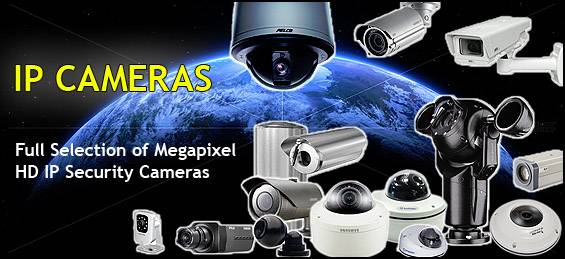
Modern IP security cameras and surveillance systems offered by Texas Surveillance & Security include a wide range of new features, including IP security cameras. These devices allow users to view footage via any computer connected to your intranet or Internet services.
Selection of IP Security Cameras
Our expansive selection of IP security camera systems provide customers with options to upgrade existing cameras to have connected capability or upgrade their existing system for improved accessibility.
With the ability to connect to a network, these IP devices remove the need for DVR or SD card recordings, allowing footage to be saved on a server remotely, improving security by removing the ability to tamper with or destroy physical media.
We also offer megapixel IP cameras that offer improved resolution and high definition footage. This is a great option for being able to clearly identify a person or object within the viewing range of your camera, or for external uses where you may need to be able to read a license plate or clearly identify an individual person.
For more information on our selection of camera devices, give us a call today.

Some of the Network Security Cameras available!
[table id=1 /]
Solar Power Security Camera Systems
[table id=2 /]
Surveillance Trailers and Mobile Command Systems!
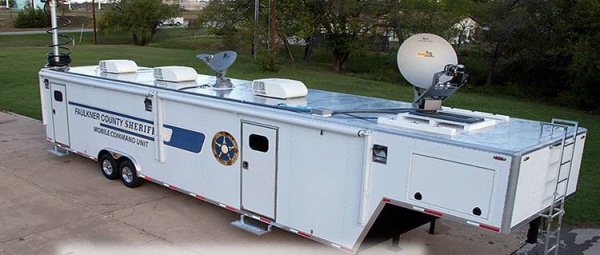
Mobile Command Center
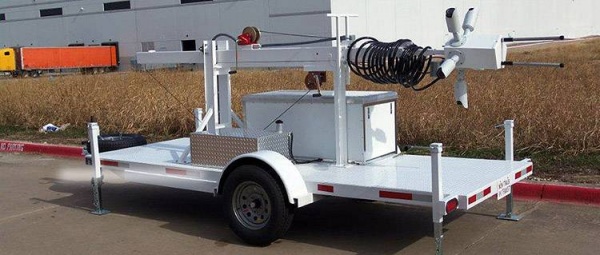
Mobile Trailer
More IP and Analog Cameras!
[table id=3 /]
Call Us NOW for a FREE QUOTE for your Business!
What separates commercial equipment from what you can buy online
The gap is not marketing. Consumer cameras are built to a price for a mild indoor climate and a homeowner who will replace them in a few years. Commercial hardware is built for continuous duty, wider temperature and humidity ranges, and sealed against the elements at the joints where cheap units fail first. On the Texas Gulf Coast that difference is measured in years of service life.
Sustained heat, high humidity, and salt air across the bay and coastal areas attack housings, cable glands and connectors relentlessly. Storm season adds wind loading that residential mounts were never engineered for. We routinely replace consumer-grade equipment that failed within two or three seasons, usually discovered at the exact moment someone needed the footage.
The other difference is the recorder. Consumer systems tie you to a manufacturer's cloud account, often with a subscription and a storage cap, and frequently with no clean way to export a clip that a police department or an insurer will accept. Commercial recorders keep the footage on your premises, under your control, exportable in standard formats, with retention you set rather than rent.
None of this means the most expensive option is automatically right. It means the cheapest option is frequently not cheap at all once you count the replacement, the lost coverage, and the incident it failed to capture.
Why Houston businesses choose Texas Surveillance
We have been a family-operated Texas company since 1993 — 33 years, Texas license B04080401. Over that time we have designed, installed and maintained commercial and industrial surveillance systems for the Houston Rockets, NRG Stadium, the George R. Brown Convention Center, the Houston Police Department, several municipal governments and fire departments, and many hundreds of warehouses, plants, dealerships, restaurants and storefronts across the region.
Two things set a commercial install apart from what you can buy in a box. The first is specification: cameras chosen and positioned against your actual sightlines, lighting and risk, rather than a package applied uniformly to every building. The second is service. Security contractors in this market appear and vanish constantly, and a system with nobody behind it becomes a liability the moment it fails. A large share of our work is maintaining and expanding systems we installed years — in some cases decades — ago.
What every system includes
Commercial-grade, weather-sealed hardware specified for Gulf Coast heat, humidity and storm season. Secure remote viewing from phone, tablet or desktop. Storage sized to the retention your risk actually requires rather than the minimum the recorder ships with. Full handover training so your people can find and export footage without calling us. And a free on-site survey before any of it — because a quote produced without walking the property is a guess.
Explore related solutions: IP cameras, 4K and megapixel systems, thermal imaging, mobile surveillance trailers, and our Texas service areas.
Commercial and Industrial IP Security Cameras — frequently asked questions
What is the difference between IP cameras and analog CCTV?
IP cameras transmit digital video over a network cable and deliver far higher resolution than analog. Analog CCTV tops out at roughly 700 TV lines; a modern IP camera delivers 4K. IP also supports AI analytics, remote access and single-cable power over Ethernet. Analog still has a place on existing infrastructure, but almost every new commercial install we do is IP.
Do I need to replace my whole system to move to IP?
Not always. Encoders can bring existing analog cameras onto an IP recorder, letting you upgrade in stages instead of all at once. We frequently phase Houston businesses over across two or three budget cycles.
How much bandwidth do IP cameras use?
A 4K camera at typical commercial settings uses roughly 8-16 Mbps recording. We normally put cameras on their own isolated network so surveillance traffic never competes with your business internet.
Can IP cameras work over WiFi?
They can, but for commercial installations we strongly prefer wired. WiFi is vulnerable to interference and jamming, and a camera that drops offline during an incident is worthless. Where cable is impossible we use point-to-point wireless bridges or cellular, which are far more robust than standard WiFi.
How many IP cameras can one recorder handle?
Commercial NVRs commonly handle 16, 32 or 64 channels. The real constraint is storage and network throughput, not channel count. We size the recorder to your camera count, resolution and required retention period.
Let's find the blind spots in your property.
A 33-year Houston company walks your site, maps the coverage you actually need, and quotes it honestly. No pressure, no obligation.